




Merijn Tinga has no doubts: a Deposit Return Scheme (DRS) for plastic bottles and cans must also be introduced in Italy. EconomiaCircolare.com met and interviewed the Dutch activist during the Italian launch of the Nice-Rome expedition, a journey of around 700 km scheduled to take place between April and May 2026.
In Italy, the initiative is carried out with the support of the national campaign “A Buon Rendere – much more than a deposit” and Marevivo, which are supporting the Plastic Soup Surfer team in coordination activities.
Can you tell us your story? How did your activism start, and how has it evolved over the years?
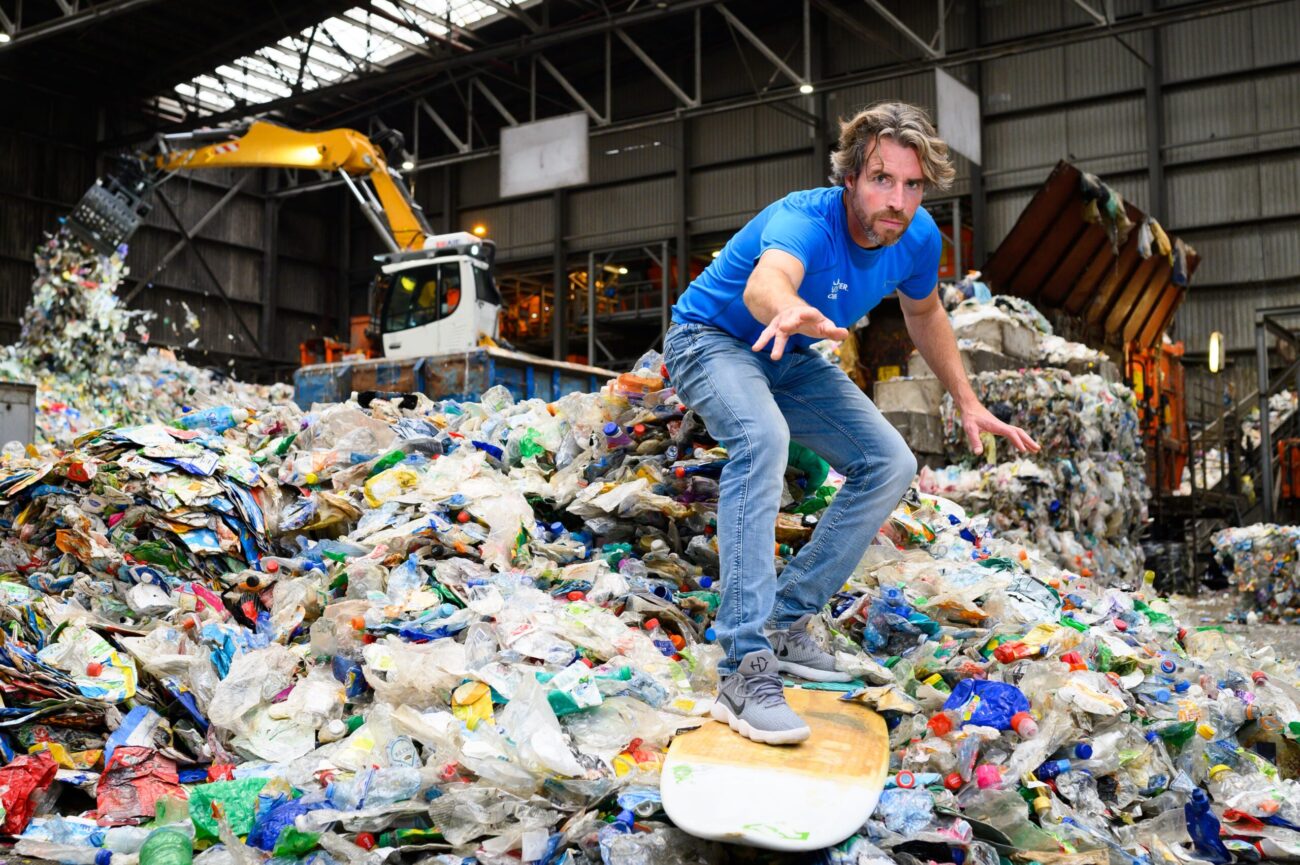
I’m a biologist and a surfer. About ten to fifteen years ago, I spent a lot of time windsurfing and kitesurfing along the Dutch coast. I often surfed long distances along deserted beaches, where I started noticing large amounts of plastic washing up on the shore. At that time, plastic pollution was only beginning to be recognized as a global problem. As a biologist, I already knew it was harmful to nature, even though we didn’t yet fully understand its long-term impacts. Still, it felt deeply wrong. I had a studio where I could build things, so I decided to make a surfboard using plastic waste collected from the beach. I had never built a surfboard before, and the result was far from perfect: it was heavy, and my attempt to break a record with it failed completely. But that failure earned me a nickname – the Plastic Soup Surfer – and that’s how my activism really began.
When did your activism move from symbolic action to political engagement?
At the beginning, the plastic movement was still very small, especially in the Netherlands. That meant you quickly got to know everyone involved – NGOs, scientists, activists, and policymakers. A year later, while sailing, I saw enormous numbers of plastic bottles floating in the sea. Many of them were Dutch bottles, washed up more than 1,500 kilometers away in countries that already had a deposit return scheme. At the same time, the Netherlands was debating whether to abolish its own system. That moment made everything clear to me: a full deposit return scheme was essential if we wanted to seriously reduce plastic pollution.
I decided to attract attention through action. I planned a kitesurf crossing of the North Sea, an adventure for me personally, but also a way to highlight the issue publicly. Alongside that, I launched a petition, which gathered more than 50,000 signatures. That was a turning point. NGOs often focus on awareness, but deposit return systems are political and financial tools. Once I entered that space, I wasn’t only talking to NGOs anymore: politicians started approaching me. A new network opened up, and the campaign became much more effective.
What strategy helped you build consensus across different political parties?
Instead of directly demanding a deposit return scheme for bottles and cans, I focused on a shared goal: less litter. I wrote a resolution calling for 90% less litter within three years, which corresponds to a government term. No political party can openly oppose reducing litter. But everyone understood that achieving a 90% reduction realistically required a deposit return system. By choosing the right language and finding common ground, it became possible to build broad political support.
What were the results of this approach in the Netherlands?
Conservative parties challenged industry to prove they could reduce litter by 90% without a deposit system. They never succeeded. Step by step, the evidence became undeniable, and the deposit return scheme was introduced. The key lesson is that small, pragmatic steps are often more effective than big, abstract ideals.
Why did you decide to focus on Italy now?
Italy does not yet have a deposit return scheme. I’ve already surfed from the Netherlands to Nice, and Spain has recently introduced the law. Italy is the next logical step. In May, I will windsurf from Nice to Rome along the coast. Along the way, I’ll meet local organizations and ask them to collect litter data: photos and information that we can analyze using AI. That data will be shared with journalists and politicians to keep attention on the issue.
Do you think a complex country like Italy – from a bureaucratic and geographical point of view – can implement a deposit return scheme?
Yes, absolutely. Of course, it requires changes in extended producer responsibility systems and in how municipalities are involved. But other countries have successfully made these changes, so there’s no reason Italy couldn’t do the same. If we want a real circular economy, producers must remain responsible for packaging throughout its entire lifecycle.
We are living through a period of profound crisis in international diplomacy, which is also affecting the fight against plastic pollution, as demonstrated by the failure of the Geneva treaty last September. Despite this context, is it still possible to be optimistic about the future of plastic recycling? Why?
If you look at Earth from space, it’s easy to become pessimistic. But when you’re actively working and surrounded by people who are also committed, you gain energy. Every concrete goal achieved shows that change is possible. Seeing real impact is what keeps you going.
How can civil society counter the influence of powerful industrial lobbies?
First of all, we need to lobby too. But we must do it with data. Industry brings numbers, jobs, and economic arguments to the table. NGOs often rely only on moral arguments. When you present objective data – trends, measurable increases, clear evidence – politicians start listening. Data transforms concern into political action.
© Riproduzione riservata



 explains why deposit return schemes are a key tool in the fight against plastic pollution)