
The third web talk of the CERES (Circular Economy Digital Innovation Hub) project, entitled “Spotlighting innovative ideas: the winning proposals from the CERES hackathons”, took place during the I-ESA international conference in Madeira, Portugal, hosted by the Uninova research institute, Instituto de Desenvolvimento de Novas Tecnologias.
The meeting, moderated by Claudio Sassanelli, associate professor at the Polytechnic University of Bari, and enriched by contributions from Theodora Kallipolitou (Zelus) and Josè Ferreira (Uninova), provided an overview of the achievements of the CERES project, in which 10 European institutions participated, including universities, training bodies and industry consortia.
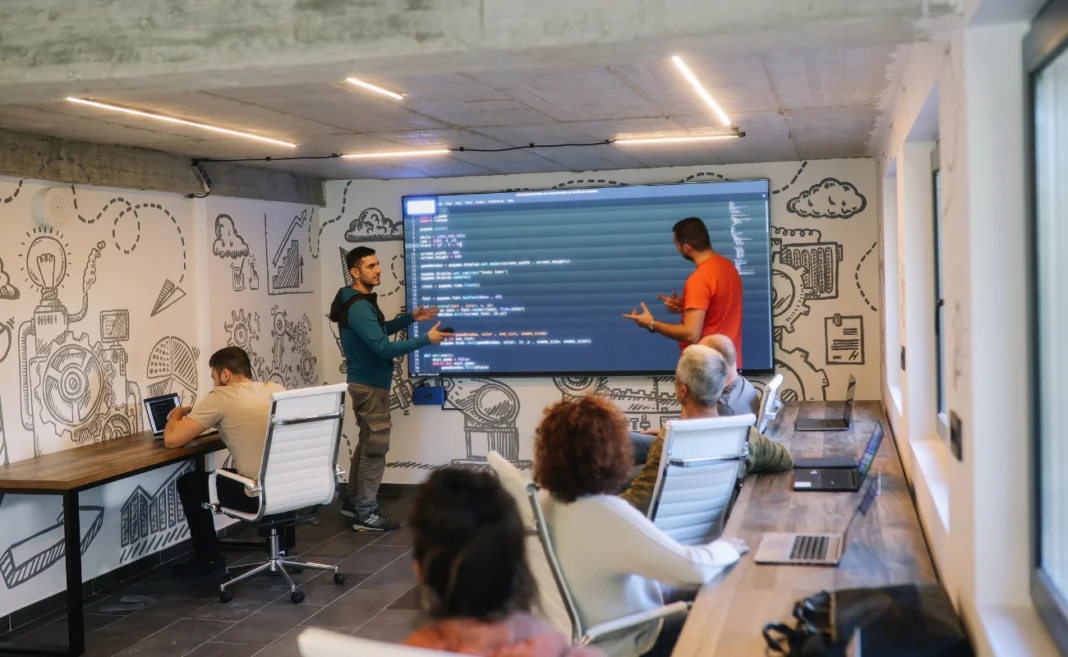
At the heart of the debate was the impact of the four transnational hackathons organised between late 2025 and March 2026 in Italy, Cyprus, Bulgaria and Denmark.
[LEGGI L’ARTICOLO IN ITALIANO]

How did the CERES hackathons go?
A hackathon – a portmanteau of ‘hack’ (finding quick and creative solutions) and ‘marathon’ – is an event where programmers, designers, marketing experts and tech enthusiasts come together to create a software or hardware prototype in a very short space of time, usually 24 or 48 hours.
The initiatives organised so far appear to have been predominantly national in scope: the CERES hackathons have therefore helped to fill this gap, proposing a model of action spread across Europe, united by a shared thematic focus, namely education on the circular economy.
The events have proved to be a useful tool for students and professionals alike, as well as for partner companies: for the former, it was an opportunity to tackle real-world challenges and the complexity of the ecological transition, applying in practice the skills acquired through CERES’s training programmes and Digital Hub.
For partner companies, however, it proved to be a way to explore new business opportunities, gather ideas and identify the best emerging talent.
Whilst maintaining a common core based on the rigorous evaluation of pitches – according to criteria of quality, originality, sustainability based on the triple bottom line, feasibility and communicative effectiveness – the events adopted different organisational formats and mentoring methodologies tailored to individual local contexts.
From the five-day hybrid format of the Italian event, which involved over 60 participants from various universities, to the sandboxing and creative brainstorming methods applied in the Danish PlayLab, the four hackathons addressed no fewer than 15 concrete business challenges.

Read also: CERES, six vocational training courses launched for the ecological transition
Actively engaging companies and students
During the talk, Claudio Sassanelli raised a key issue regarding the organisation of this type of event, namely how to keep participants’ enthusiasm alive, even when the pressure of the challenge is considerable. A cash prize is one option, as is emphasising the social aspect of the event or using figures who attract the attention of young people, such as YouTubers, but of course this is not enough.
In this regard, Theodora Kallipolitou shared her experience both as a participant and as a hackathon organiser: “I think the active involvement of the company or institution setting the challenge is very important. But if the ‘challenger’ isn’t involved, the solution would be to focus on one of the stages of the circular challenge. Even if you don’t know the problem, you have to make assumptions, as in a systems thinking solution.”
On the other hand, involving companies in these events is equally complex, as the staff who would be responsible for mentoring usually work during those hours.
“One solution, which I have already tried with good results – said José Ferreira – is to give companies the opportunity to invite students as interns or employees. In this way, companies choose the best candidates and students are motivated to work for that company.”
Read also: Bridging the skills gap for the circular transition: CERES advanced training courses now available
© Riproduzione riservata