
0303To optimize a process, it is analyzed and examined closely to identify the least efficient phases, understand the reasons for suboptimal yields, and correct errors. Today, in Europe, we purchase a vast number of electrical and electronic equipment (EEE) containing large quantities and a wide variety of precious materials, such as so-called critical raw materials (CRMs): valuable in terms of environmental impacts associated with extraction, transport, and processing; valuable in terms of market costs (often influenced by complex geopolitical conditions and the concentration of extraction in a few countries); and valuable in terms of the needs of European industry, including sectors linked to decarbonization.
What appears to be a positive scenario—a continent that does not possess the raw materials it needs in its own subsoil but can find them in consumer goods on the market—is positive only potentially. Europe is not yet able to take full advantage of all the electrical and electronic equipment (EEE) in circulation once it becomes waste. So, what isn’t working?
We know that Europe’s “urban mine” is only partially an immediately available resource. Thanks to the European FutuRaM project, funded under Horizon Europe, it is now clearer that we are dealing with a potential dispersed across millions of products, components, and waste streams.
Turning this potential into effective secondary supply requires technology, of course. But first and foremost, it is necessary to intercept this potential: there must be traceability, quality of flows, the ability to know where critical raw materials are before they are lost, and high-quality data.
Read also the Special report FutuRaM
The Heart of the Problem Lies in the Losses
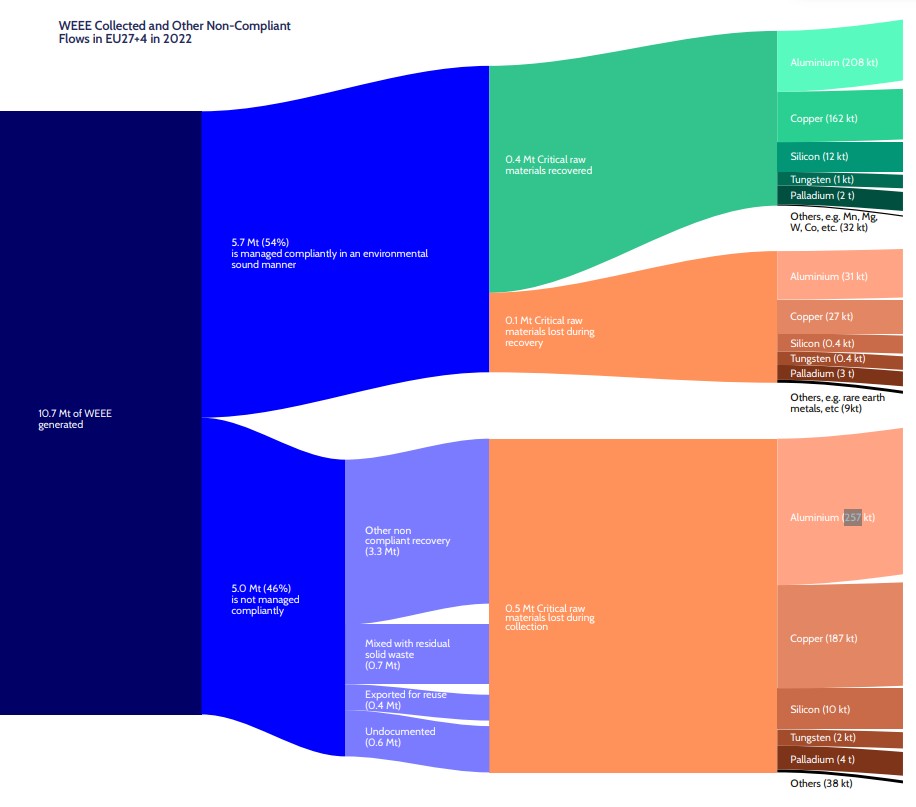
In 2022, in the EU27+4 area — European Union, Iceland, Norway, Switzerland, and the United Kingdom — 10.7 million tonnes of waste were generated from electrical and electronic equipment (WEEE), roughly 20 kg per person — a significant amount.
Within this waste, approximately 1 million tonnes of critical raw materials were embedded: copper in cables, aluminum in casings, rare earths in magnets and fluorescent powders, and platinum-group metals in electronic boards.
Here, entropy begins. Only half or slightly more — 5.7 million tonnes of WEEE, 54% — were collected and treated properly, meaning in a way that enables the recovery of the industrial, environmental, and economic value they contain.
Of the approximately 1 million tonnes of critical raw materials present in WEEE, only 0.4 million tonnes become theoretically available for recovery; 0.5 million tonnes are lost during collection, and 0.1 million tonnes during recovery. The largest loss, therefore, occurs before the treatment and recycling facility.
From these flows, approximately 0.4 million tonnes of those valuable raw materials were made available for recovery. If we were dealing with a string of pearls whose broken thread needed replacing, we would have lost more than half. This is hardly acceptable given Europe’s high demand. The gap between these numbers is at the heart of the problem, a problem that extends across all stages of the recycling value chain.
The Limits of Recycling Are Limits of the Value Chain
Those who read EconomiaCircolare.com and are aware of the very low data on the collection of electrical and electronic waste know that losses begin well before the recycling process. Yet insufficient collection alone does not explain the scale of the waste. Let’s therefore take a broader view to observe the entire value chain.
The critical stages, as shown by analyses from the FutuRaM project, are at least four:
- Collection, where WEEE may not be intercepted;
- Non-compliant flows, where waste is mixed, exported, or not documented;
- Pre-treatment, where dismantling and separation may fail to isolate components rich in critical materials;
- Recycling, where some materials, especially if present in small quantities or highly dispersed, are not recovered.
The Missing Collection
The first point where a significant portion of the waste we are discussing occurs is collection. According to FutuRaM, in 2022 approximately 0.5 million tonnes of critical raw materials present in WEEE were lost at this stage: 257 kt of aluminum, 187 kt of copper, 10 kt of silicon, 2 kt of tungsten, 4 tonnes of palladium, and about 9 kt of other materials, including rare earths. This is the data that shifts the focus of the discussion: without intercepting the flows, recovery is impossible, no matter how advanced the downstream technology is.
The reason, as mentioned earlier, is that almost half of the WEEE generated escapes compliant management. Of the 10.7 million tonnes produced in 2022, 5 million tonnes — 46% — were not collected or treated properly. Of these:
- 3.3 million tonnes end up in non-compliant recovery processes, often mixed with metallic or plastic waste;
- 0.7 million tonnes are disposed of with mixed municipal waste, sent to landfill or incineration;
- 0.4 million tonnes are exported for reuse;
- 0.6 million tonnes disappear from the radar, remain undocumented, and are probably illegally exported or processed through informal channels.
Read also: 2050: when the Energy Transition Also Becomes an End-of-Life Challenge
A Mix That Dilutes Value
The second crucial point where the European economy is deprived of its valuable WEEE—and thus of materials important for our future—lies in the loss of quality in waste streams. When WEEE is mixed with other waste, the system can only recover some of the simpler fractions—such as iron, steel, and sometimes copper or aluminum—while access to materials contained in complex components, often in very small quantities, is virtually impossible.
It would be a mistake to think that the much-discussed “urban mine” can be reduced solely to a question of quantity: the quality of the stream reaching the facilities also matters—and matters a lot.
Pre-treatment and Information
The third weak link in the process is pre-treatment: dismantling, cleaning, shredding, and separation. WEEE consists of complex products made of different materials connected at the assembly level or even chemically. After selective dismantling, products or components are often shredded and separated, but the process is only partially successful: some materials remain attached or mixed with others, which affects the possibility of recovering them.
For this reason (as discussed here LINK Article 4), it is not enough to know that a critical raw material is present in a waste item: it is necessary to know which component contains it and whether (and how) that component can be separated from the rest. Palladium, rare earths, tungsten, or neodymium are not uniformly distributed in WEEE. They may be concentrated in electronic boards, hard drives, permanent magnets, displays, cables, compressors, or photovoltaic cells. If these components are not identified and separated, the critical material remains hidden within the waste stream.
Recycling
And now we come to recycling, which also plays a key role in the loss of materials during its process. Even when WEEE enters the appropriate channels, not all raw materials are recovered. In 2022, despite proper collection and treatment, approximately 0.1 million tonnes of critical raw materials were not recovered. The losses mainly concern rare earths such as neodymium, dysprosium, yttrium, and europium—materials essential for magnets, fluorescent powders, and electronics.
The reasons are both technical and economic. Some critical raw materials are present in very small quantities, dispersed across many products, or incorporated into components that are difficult to process. For example, antimony, strontium, and yttrium were almost entirely unrecovered in 2022 (LINK ARTICLE 4); palladium showed a low recovery rate, with only 2 tonnes theoretically available out of 9 tonnes present. Without dedicated technologies and policies, many of these materials will continue to be lost in the future.
This highlights the crucial difference between “recovery” and “recoverability.” Recovery indicates what actually occurs in the process: it measures what remains available for production purposes. Recoverability, on the other hand, indicates whether a critical raw material can potentially be recovered, taking into account technical, economic, environmental, and legal factors. A material may be present in a waste stream, but not realistically recoverable if it is too dispersed in other materials, if mature recovery technologies are lacking, if the flow is of low quality, or if economic conditions do not make recovery profitable.
Read also: CRM in EU Electronic Waste: Knowing How Many Is Not Enough
The Crucial Role of Data
If the technical aspect is, as is well known, extremely important, the same applies to information: even data—the limited availability of data—is part of the problem. If the composition, components, quality, and fate of flows are not known, it is difficult to estimate which materials are lost, where, and where intervention is worthwhile. This is also the role of the FutuRaM project, whose results highlighted the difficulties caused by insufficient availability and poor granularity of data: information is missing for certain product groups, at some levels of the product-component-material-element hierarchy, or for specific components.
To assess tantalum in a laptop, for example, and then recycle it, it is not enough to know that there is an electronic board in the product: one must know whether there are tantalum capacitors.
The issue, as is often the case, also involves measurement, and is therefore statistical. The analysis of material flows, which the European project focuses on, is used to estimate not only the quantity of secondary raw materials available, but also their location, quality, and accessibility. For critical raw materials, where primary supply may be limited by geopolitical, economic, and environmental constraints, monitoring stocks and flows across the entire life cycle—extraction, production, use, end-of-life, and recovery—becomes essential for unbiased public decision-making, avoiding short-sightedness or tunnel vision.
Read also: WEEE Recycling, Arienti (Erion): “Collecting more is not enough, without quality”
How to Reduce Gaps in the Critical Secondary Raw Materials System
This leads to the proposal to improve statistical classification codes. Among the recommendations of the European project is to “adapt the PRODCOM (the annual EU‑harmonised industrial production survey) and EU List of Waste codes to improve capture of data for secondary raw materials”
This would involve adding 30 new codes to the PRODCOM classification and 43 to the EU Waste List. These codes would specifically aim to capture “components that can be dismantled during waste management and have a high critical raw material recovery potential and are mentioned in Article 26 of the CRM-Act, such as waste printed circuit boards, permanent magnets containing rare earth elements, black mass, and batteries that can be prepared for reuse.”
The solutions proposed within the FutuRaM project obviously target all stages where significant losses have been observed. They are as follows:
- First, increasing compliant collection: more WEEE entering official channels means more materials potentially available for recovery.
- Second, improving source separation and stream quality, preventing electronic equipment from being mixed with metal, plastic, or general waste.
- Third, identifying and separating components rich in critical raw materials before they are shredded or dispersed.
- Fourth, addressing the upstream phase of the value chain and product design: equipment that is easier to disassemble, repair, and separate allows better recovery of strategic components.
- Fifth, focusing on data, so that gradually harmonized, granular, and comparable information becomes available, collected according to common classifications and standardized product/component lists. Digital Product Passports, Battery Passports, composition reports, Bills of Materials, and harmonized classifications can make visible what is currently lost in the complexity of waste streams.
- Sixth, concerning facilities and industrial policies: Europe needs recovery capacity, more selective technologies, economic incentives, and planning that links collection, treatment, and industrial demand for secondary raw materials.
© All rights reserved
Download the full FutuRaM Special as a PDF