
The new phase of Europe’s critical raw materials strategy has brought an important awareness: it is necessary to know not only how much material is present in electrical and electronic equipment, but also where it is, in which components, with what level of recoverability, in which year it will become available, and with which technologies it can re-enter the economy. This is where a seemingly technical project like FutuRaM, supported by the European Union, intersects with the heart of the Old Continent’s industrial policy. Dependence on critical raw materials is not reduced simply by opening mines, signing trade agreements, or fast-tracking authorizations. It is also reduced by building public and industrial capacity to understand the European “urban mine” as a strategic infrastructure.
The Critical Raw Materials Act (CRMA) sets ambitious 2030 targets for extraction, processing, recycling, and reducing dependency. However, the real goal is to translate those targets into actionable policies and guidelines, facilities, shared and interoperable data, fast-track authorizations, secondary markets, recovery capacities, and the construction of value chains capable of keeping processing and transformation of products within European borders.
Read also the Special report FutuRaM
The New Geography of Industrial Security
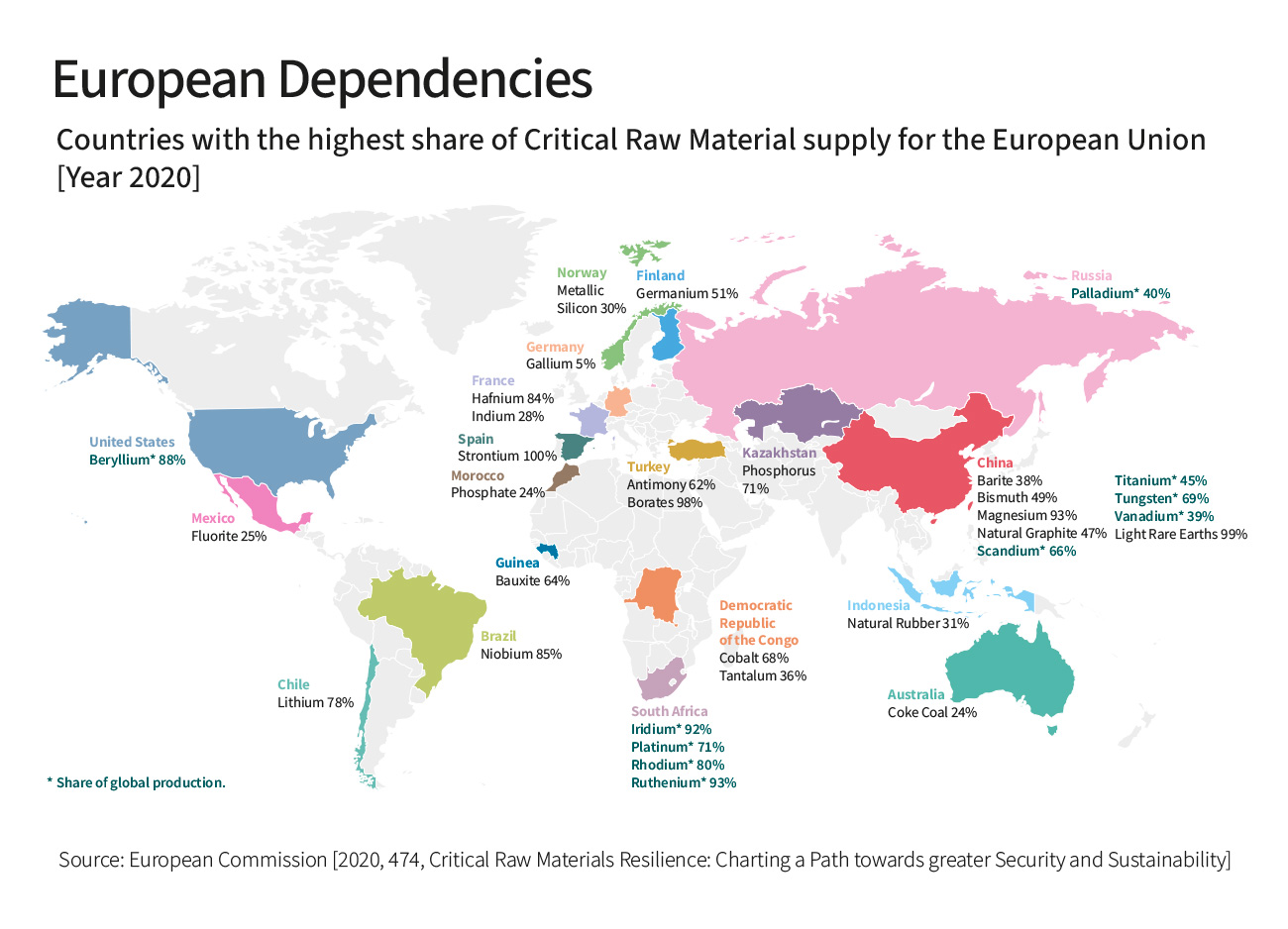
As is well known, critical raw materials are essential for renewables, energy storage, digital technologies, aerospace, and defense. In this context, the European Commission reports that European demand for rare earths could grow sixfold by 2030 and sevenfold by 2050, while lithium demand could increase twelvefold by 2030 and twenty-onefold by 2050. However, Europe’s challenge is not simply its dependence on imports of these raw materials. The real vulnerability lies in the fact that key stages of the value chain—such as refining, separation, magnet production, and component manufacturing—are concentrated outside the European Union. The risk, therefore, is that Europe may finance decarbonization and the so-called “twin transition” without possessing sufficient industrial levers to govern it. This is why it is crucial to implement a raw materials policy that combines strategic autonomy, economic security, sustainability, and industrial policy.
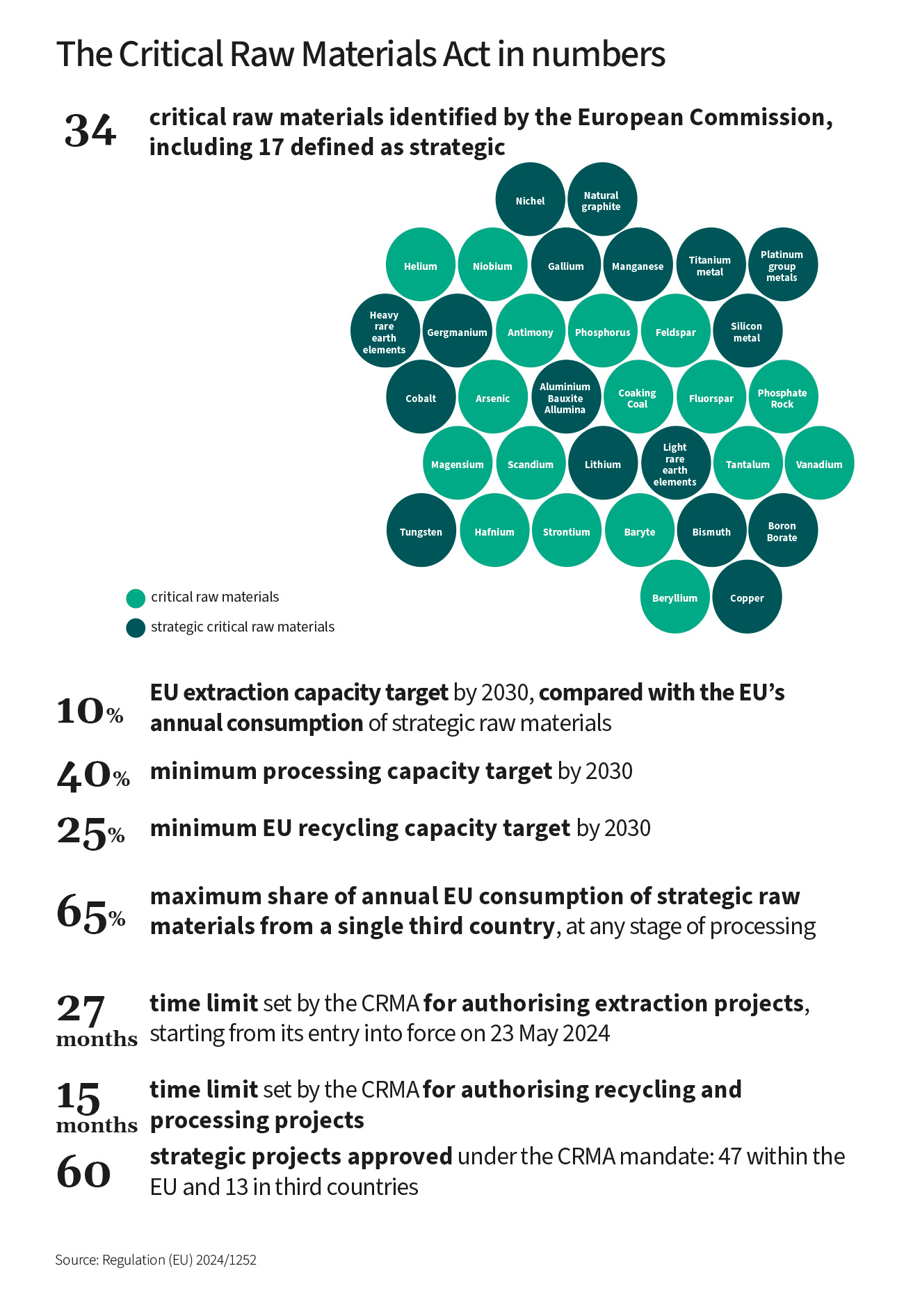
The CRMA acts on multiple levels: lists of critical and strategic raw materials, Strategic Projects, faster authorisations, stress tests, supply chain monitoring, national exploration programmes, recovery from waste and extractive residues, requirements on permanent magnets, and increased circularity. For projects selected as “Strategic Projects,” the regulation also provides support for access to finance and shorter authorisation timelines: 27 months for extraction permits and 15 months for processing and recycling. This represents a profound transformation of the public role. The aim is to directly shape the architecture of value chains, but here the first bottleneck emerges. Without reliable data on available secondary resources, losses along the value chain, and priority components, European policy risks operating between ambitious targets and insufficient operational capacity.
The Urban Mine as a Knowledge Infrastructure
The first testbed came in 2025 with the selection of Strategic Projects. The Commission approved those located within the EU on 25 March 2025 and those outside the EU on 4 June 2025: they concern the extraction, processing, recycling, and substitution of 14 strategic raw materials. The 47 projects within the European Union are designed to strengthen domestic capacities for strategic raw materials, while the first 13 projects outside the EU aim to diversify supply sources. This represents a strong push to reduce the riskiest dependencies, build capacity in currently weak segments, and leverage the Single Market to support projects across the entire value chain. This push requires rapid timelines but clashes with the need to initiate exploration of new extraction facilities, authorize recovery, processing, and transformation plants, secure capital, expertise, and technologies, as well as properly consider community involvement and the social acceptability of the proposed infrastructure. The European Court of Auditors, in its Special Report on critical raw materials and the energy transition, warned that measures to diversify imports, increase domestic production, and improve resource management are still not producing sufficient results to secure the process. This is why urban mines become a decisive terrain, as they can reduce pressure on global markets, lower vulnerability, and create European value chains less exposed to geopolitical shocks, likely in a shorter timeframe than primary supply.
The FutuRaM project sits squarely in this gray area between knowledge, statistics, and industrial policy, developing a knowledge base on secondary raw materials with a particular focus on critical ones. It produces highly useful datasets, but above all it directs attention to the specific understanding of the flows, the components in which materials are contained, and their recoverability. This information, in turn, allows focus on the technical and economic chain needed to truly valorize urban mines. An electronic board, a permanent magnet, an electric motor, a battery, or a photovoltaic panel are not equivalent from a recovery perspective. They differ in material concentration, dispersion, disassembly feasibility, available technology, economic value of the recoverable fraction, applicable regulations, and market presence. Here, the connection with the CRMA becomes direct. If Europe wants to reach a 25% recycling capacity relative to annual strategic raw material consumption, it must know which flows can realistically contribute to that goal.
Read also: Leroy (WEEE Forum): “ FutuRaM? ‘An enabling layer’ for EU CRMs Regulations”
From Raw Materials Diplomacy to Aggregated Demand
Along this line of action is the creation, by the European Union, of common market instruments. The Raw Materials Mechanism, part of the EU Energy and Raw Materials Platform, was launched in November 2025 with the goal of connecting industrial demand, global suppliers, financial institutions, and storage solutions. The Commission describes it as a tool to aggregate demand, promote joint purchasing, develop strategic projects, and connect off-takers (producers committed to supplying a good at a set price for a defined period) with investors.
Beyond promoting partnerships or funding individual projects, the EU is therefore seeking to build a collective capacity for purchasing and demand coordination, in order to support companies that, on their own, lack sufficient bargaining power, time horizon, or financial instruments to carry out projects alternative to supply chains dominated by large non-European players.
But here too, the secondary dimension is decisive. If the platform is used only to better purchase primary raw materials, it will remain a diversification tool. If, however, it manages to include secondary raw materials, off-take agreements for recovered materials, strategic stocks, and data on waste hotspots, it can become a component of industrial circular policy. FutuRaM provides the informational support for this leap: the Urban Mine Platform is designed to integrate datasets useful for identifying material hotspots and supporting coherent policies for the recovery of critical and strategic raw materials.
Clean Industrial Deal and Industrial Accelerator Act
The strategy on critical raw materials does not advance in isolation. The Clean Industrial Deal, presented by the Commission on 26 February 2025, was designed to turn decarbonization into a driver of industrial growth, with a focus on energy-intensive industries—steel, metals, chemicals—and cleantech. Within this framework, circularity is explicitly highlighted as a tool to reduce waste, extend the lifespan of materials, and decrease dependence on non‑EU suppliers of raw materials. The subsequent Industrial Accelerator Act, proposed by the Commission on 4 March 2026, pushes this logic even further. The new measures target strategic sectors such as steel, cement, aluminum, automotive, and net-zero technologies, with the possibility of extension to other energy-intensive industries. The goal is to accelerate industrial capacity and decarbonization, also through faster and digitalized permitting procedures.
The link with critical raw materials is deeper than it might seem at first glance. If Europe wants to revive clean manufacturing, batteries, electric vehicles, renewables, electrolyzers, semiconductors, defense, and data centers, it will need to manage three markets simultaneously: energy, technology, and materials. In this sense, the Clean Industrial Deal and the CRMA are two facets of the same policy: the first aims to create demand and industrial capacity, while the second seeks to secure the material inputs for that capacity.
The risk, however, is that public or incentivized demand focuses solely on “Made in Europe” content without a sufficient European infrastructure for secondary materials. Rewarding European products made with critical raw materials imported from fragile or concentrated supply chains would not truly make the EU economy resilient. European industrial policy will therefore need to avoid an artificial separation between manufacturing and recycling, between final product and raw material, and between green public procurement and recovery capacity.
Read also: FutuRaM Project: Urban Mining at the Core of European Industrial Policy
RESourceEU: Between Economic Security and Circularity
RESourceEU also plays a prominent role within the European framework of initiatives designed to accelerate the creation of a European market and value chain for critical raw materials. This action plan was adopted by the European Commission in December 2025 as the application of the REPowerEU logic to raw materials: reducing deep dependencies through diversification, financial instruments, public-private coordination, and shared operational capacities. RESourceEU introduces or strengthens tools such as a European Critical Raw Materials Centre, a coordinated approach to stock management, a joint procurement mechanism via the Raw Materials Platform, and measures to reinforce the secondary market, particularly for permanent magnets and critical materials linked to strategic industrial sectors.
Europe has begun to build the framework: CRMA, Strategic Projects, Raw Materials Mechanism, RESourceEU, Clean Industrial Deal, Industrial Accelerator Act. It now needs to ensure that these tools do not operate in parallel without integration. Reducing dependency will not be the result of a single regulation, but of the ability to connect industrial policy, circularity, and material knowledge. This is where FutuRaM intersects with European policies, providing the informational conditions so that strategic autonomy does not remain a slogan and the new European industrial policy does not become a victim of the materials it should be learning to govern.
© All Rights Reserved
Download the full FutuRaM Special as a PDF