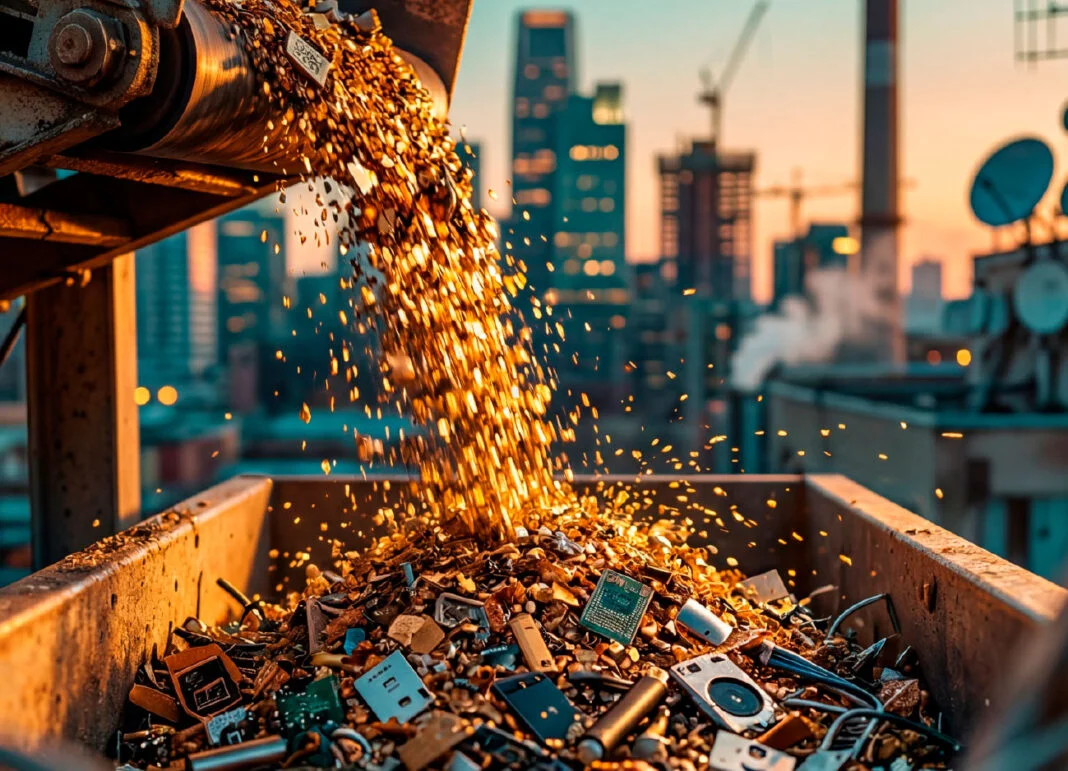

Inside an old smartphone, a decommissioned washing machine, a discarded monitor, or an end-of-life photovoltaic panel, there may be copper, aluminum, palladium, silicon, tungsten, and rare earth elements. All of these are crucial materials for the green and digital transition, yet in Europe they are exposed to supply risks and a high dependency on external suppliers. And it is precisely this dependency that makes waste electrical and electronic equipment (WEEE), such as those just mentioned, a potential reservoir of these valuable raw materials. From there, we could procure materials to meet the needs of decarbonization and the electrification of society and the economy. But the question is not only how much critical raw material (CRM) WEEE contains. The decisive question is rather: how much of that material can we actually recover?
The difference may seem technical, but it is political, industrial, and environmental. A material can be present in waste and yet be almost unreachable: dispersed in tiny quantities, embedded in miniaturized components, mixed with other materials, lost in non-compliant collection, or sent to treatments that only recover the easiest fractions. The European FutuRaM project, funded under the EU Horizon Europe program, seeks to make explicit and measurable the gap between content and recoverability. It is not enough to know “how much material there is”: it is necessary to know where it is located, how it is bound to the product, and what happens when that product becomes waste.
For this reason, according to Pascal Leroy, Director General of the WEEE Forum (a not-for-profit association of 49 WEEE producer responsibility organisations across the world), FutuRaM is “part of a broader security‑of‑supply strategy: reducing dependence on a few non‑EU suppliers for materials essential to the green, digital and defence transitions, and aligning secondary resource planning with primary raw materials policy.”
Read also the Special report FutuRaM
From Content to Recoverability: The FutuRaM Project
Critical raw materials are present in electrical and electronic waste (WEEE), that much we know. But that is not enough. The decisive point is to understand where they are located, in which specific component, in what form, how dispersed they are, and whether collection and treatment systems can intercept, separate, and direct them to recycling without losses.
“The mere presence of a material in WEEE does not imply its actual recoverability. Recoverability depends on several enabling factors—or, conversely, barriers: product design, concentration and distribution of materials, available recycling technologies, economic feasibility, and collection and pre-treatment systems.” tells EconomiaCircolare.com Giulia Iattoni, Assistant Programme Officer at the United Nations Institute for Training and Research (UNITAR). “Some materials already achieve high levels of recovery today thanks to favorable properties and well-established technologies. Others represent flows with growing strategic interest and recovery potential, linked to the evolution and market penetration of the products containing them and to existing treatment processes. Conversely, some materials remain difficult to recover due to their dispersion within products and current technological limits, and are recovered only in limited quantities or through processes still under development.”
The FutuRaM project shifts the focus from mere “content” to “recoverability.” As summarized in one of the project’s deliverables (D3.1 Extended Waste Stream Composition Assessment to Enable Secondary Raw Material Assessment), “composition data is essential for understanding which strategic and critical raw materials are present in the waste streams, where they are located, e.g. in which components or materials, and how they can be recovered.”
A “Messy” Urban Mine
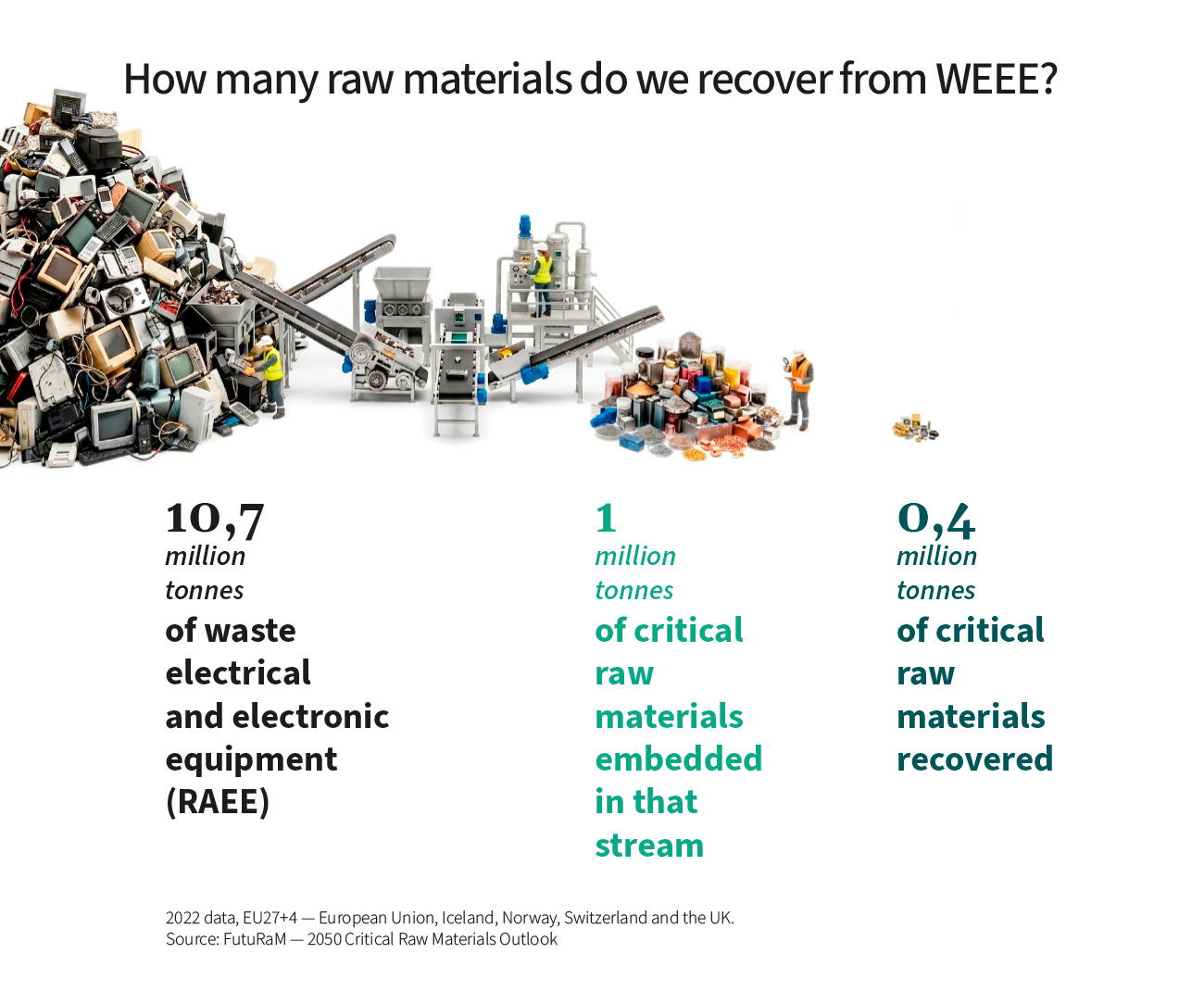
The 2050 Critical Raw Materials Outlook report provides illuminating data on this. In 2022, within the EU27+4 area (European Union, United Kingdom, Iceland, Norway, and Switzerland), 10.7 million tonnes of WEEE were generated — roughly 20 kg per person. These waste streams contained about 1 million tonnes of 29 materials that the EU has classified as critical raw materials: “Materials of high importance to the EU economy and of high risk associated with their supply.” The report cites very concrete examples: copper in cables, aluminum in casings, rare earths in magnets, and platinum group metals in electronic boards and displays. We have learned to consider WEEE as an “urban mine,” but it is essential not to forget that it is a “messy urban mine,” composed of diverse items, components glued, soldered, miniaturized, or difficult to access.
The difference between content and recoverability becomes clear with a simple question: if an old laptop or a monitor contains copper, palladium, or rare earths, are these materials automatically and easily recoverable? Not at all.
A Hierarchical Approach to Raw Materials
The recoverability of critical raw materials depends on several factors, which, ideally, should be considered during the product design phase. It depends primarily on their location. A material in a cable that can be easily separated does not share the same fate as an element dispersed in tiny quantities within a circuit board, a magnet, a display, or a composite component. For this reason, FutuRaM adopts an approach that follows a hierarchical structure: product, component, material, element. In other words, it does not simply record that a WEEE item contains a certain amount of copper, aluminum, or rare earths; it aims to reconstruct where these materials are located within the product, moving step by step from a higher-level to a lower-level hierarchy.
In the approach employed by the project, each element (neodymium, for example) is linked to a material (permanent magnet), each material to a component (hard disk), and each component to a product (laptop). The document also specifies that the dataset of electrical and electronic equipment/WEEE created for the project covers 80 components, 23 materials, and 64 elements, precisely to map their composition in a highly granular way.
This hierarchical approach can be decisive because WEEE are complex, multi-material objects. Recycling does not consist of simply “melting everything down” to automatically obtain high-quality secondary raw materials. First, the materials must be “liberated”: dismantled, separated, shredded, and sorted. Each step can generate losses. The “Extended Waste Stream Composition Assessment” document explains that the possibilities and limits of recycling are “strongly influenced by the performance of the liberation and separation processes.” It also notes that these processes are often “only partially successful,” leaving valuable materials fixed or mixed together due to connections established during the design phase.
Read also: FutuRaM Project: Urban Mining at the Core of European Industrial Policy
Recoverability or Recovery? The Data
This is where “recoverability” and “recovery” diverge: “While recovery and recycling measure the efficiency of obtaining a constituent or material after processing or waste treatment, recoverability addresses the potential to recover that constituent or material in the first place.” Recovery measures the efficiency of the process—it quantifies the actual outcome achieved—whereas recoverability stops earlier, at the theoretical potential for recycling. It evaluates whether a material can be recovered, with which technologies, at what costs, and under which regulatory or environmental constraints.
What may seem like a purely terminological distinction actually translates into sometimes striking results.
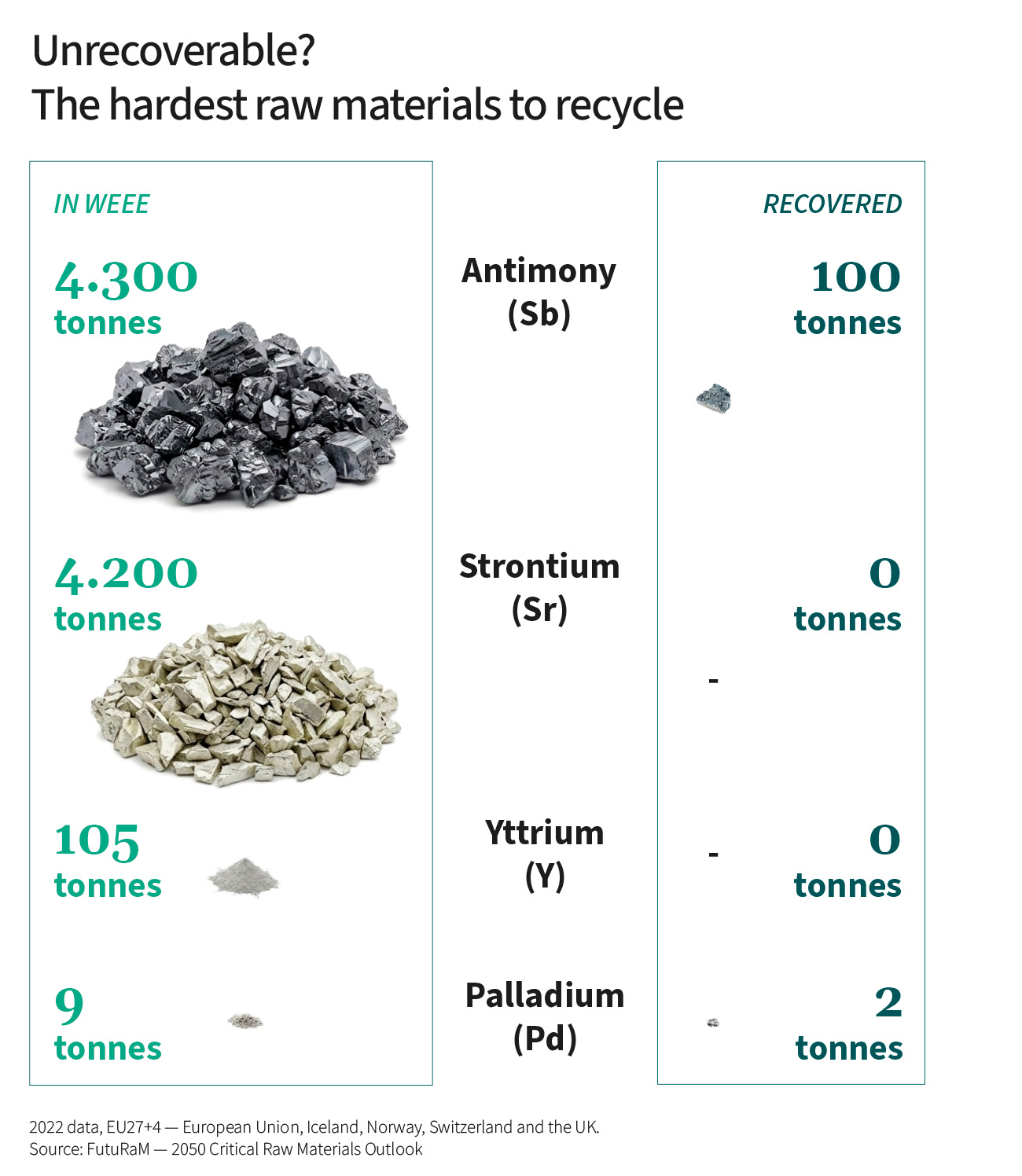
Looking at 2022, of the 10.7 million tonnes of WEEE generated in the EU+4, only 5.7 million tonnes — 54% — were properly collected and treated. From these streams, approximately 0.4 million tonnes of critical raw materials were recovered, including 208 kt of aluminium, 162 kt of copper, 12 kt of silicon, 1 kt of tungsten, and 2 tonnes of palladium. However, even within properly managed flows there are losses: around 100,000 tonnes of CRMs were not recovered, particularly rare earths such as neodymium, dysprosium, yttrium, and europium, which are present in magnets, fluorescent powders, and electronic components.
The largest losses, however, occur even before treatment: during collection. In 2022, 46% of WEEE — around 5 million tonnes — did not enter proper collection and treatment channels. Part of it ended up in non-compliant recovery processes, where only the easier-to-recover materials such as iron or steel could be extracted, often at lower standards; 0.7 million tonnes went to mixed municipal waste, and therefore to landfill or incineration; 0.4 million tonnes were exported for reuse; the rest is “undocumented,” likely exported illegally or treated through informal channels.
Here, critical materials are present — it’s the collection system that’s lacking.
Technical and Economic Aspects of Recycling
To put things in perspective, copper and aluminum are already recovered at a significant scale, partly because they are present in more recognizable components or fractions, such as cables, casings, and frames. Yet even for these materials, not everything is straightforward: internal cables or very small components can be difficult to handle. Some critical materials, on the other hand, are present in small quantities, dispersed, or embedded in components that are hard to separate. This is the case for rare earth elements in permanent magnets, fluorescent powders, or certain precious metals in electronic boards and displays.
As the report notes, “CRMs with low mass fractions/grades and content in products and waste flows, small amounts/tonnages and high dissipation generally showed lower recoverability.” In these cases, recycling is indeed a challenge—both technically and economically: if the material is sparsely concentrated, if the flows are small or variable, if there is no stable market or no specific legal recovery obligation, the recovery operation may not be cost-effective.
Read also: Improving Flows to Recycle More: Where Critical Raw Materials Are Lost
The Palladium Paradox
A striking example is palladium. In WEEE, Pd—its symbol in the periodic table—is mainly found in electronic boards, hard disks, and LCD and plasma displays. According to FutuRaM estimates for 2022, about 2 tonnes of palladium were recovered, while 4 tonnes (double that amount) were lost during collection, and 3 tonnes were lost during treatment and recovery. Consequently, only slightly more than one-fifth is theoretically available for recovery.
We are therefore facing a paradox: the majority of this high-value material is lost because it does not enter the correct stream or is not properly separated.
Future estimates predict improvements, but not fully decisive ones. By 2050, with an estimated 6–12 tonnes of palladium per year in WEEE (depending on the scenario), the theoretically recoverable share is projected to be between 2 and 9 tonnes.
One of the project reports explains: “The recoverability of platinum, palladium and rhodium from the catalysts in ELVs is well established due to their high economic value and concentrated presence in catalysts. However, fluctuating precious metal prices and the need for efficient dismantling and processing technologies remain important factors influencing recovery efficiency.”
Estimates for 2050
Overall, the 2050 forecasting models employed by the European project confirm that increasing collection volumes alone will not be sufficient: the system as a whole needs to be improved. According to FutuRaM, the quantity of WEEE in the EU27+4 area could rise from 10.7 Mt in 2022 to a range between 12.5 and 19 Mt. The critical raw materials contained in WEEE could increase to 1.2–1.9 Mt. The share available for recovery could reach 0.9–1.5 Mt, but significant losses would remain: between 200,000 and 800,000 tonnes during collection, and between 100,000 and 200,000 tonnes during recovery. Therefore, even in the best-case scenario, the urban mine will not empty itself: the waste it contains must be redesigned, collected, dismantled, and treated properly.
As Iattoni explains, “the future scenarios developed in FutuRaM (business-as-usual, recovery, and circularity) are not forecasts, but represent possible developments up to 2050 based on changes in collection systems, recycling technologies, and market dynamics, allowing an assessment of how these conditions influence the availability and recovery of critical raw materials from WEEE and the achievement of the targets.”
Why are these estimates important? According to the Director General of the WEEE Forum, they will allow “to set realistic yet ambitious targets for CRM recovery, eco‑design, collection and recycling in implementing the CRMA (e.g. Articles on recovery from extractive waste and products containing CRMs) and in revising waste and product legislation (WEEE, batteries, ELV, construction).”
They will also allow to “prioritise waste streams and technologies with the highest recoverable CRM potential when allocating EU funding, designating Strategic Projects under the CRMA, or designing Industrial Accelerator Act (IAA) support measures for low‑carbon, EU‑origin materials.”
Read also: Iattoni (UNITAR): “Invest in data quality to guide decisions for recovery of critical raw materials”
A Range of Necessary Interventions
The solution outlined in the documents is not — and could not be — a single one, but a chain of measures.
Here are the steps listed below:
Increase compliant collection, because materials that do not enter the formal collection and treatment system are unlikely to become secondary raw materials. New sorting technologies (such as LIBS—Laser-Induced Breakdown Spectroscopy—or XRF—X-Ray Fluorescence, useful tools for distinguishing compositions, materials, and alloys) can help, but they do not replace proper collection, source separation, and design for disassembly.
Identify products and components rich in critical raw materials, to direct them towards targeted treatment processes.
Design products for easier disassembly, because ecodesign aimed at separation helps prevent valuable materials from being lost in mixed waste streams or undifferentiated shredding. Labelling will also be important: to know, possibly through the digital product passport, which and how many raw materials are in the waste and where they are located (and potentially how to separate them from other components).
Create economic and regulatory conditions that make CRM recovery profitable, even when they are present in small quantities or embedded in components that are difficult to separate.
Strengthen data infrastructures. Data themselves are, in fact, part of the recycling infrastructure. If producers, collective systems, treatment facilities, and authorities do not use compatible classifications and vocabularies for products, components, materials, and codes, it will be difficult to know where to intervene and which fractions to direct toward targeted recovery. Harmonized composition data, granular enough to reflect the separability of parts containing critical raw materials, will be needed. Tools such as the digital product passport will also be necessary to convey this information.
© All rights reserved