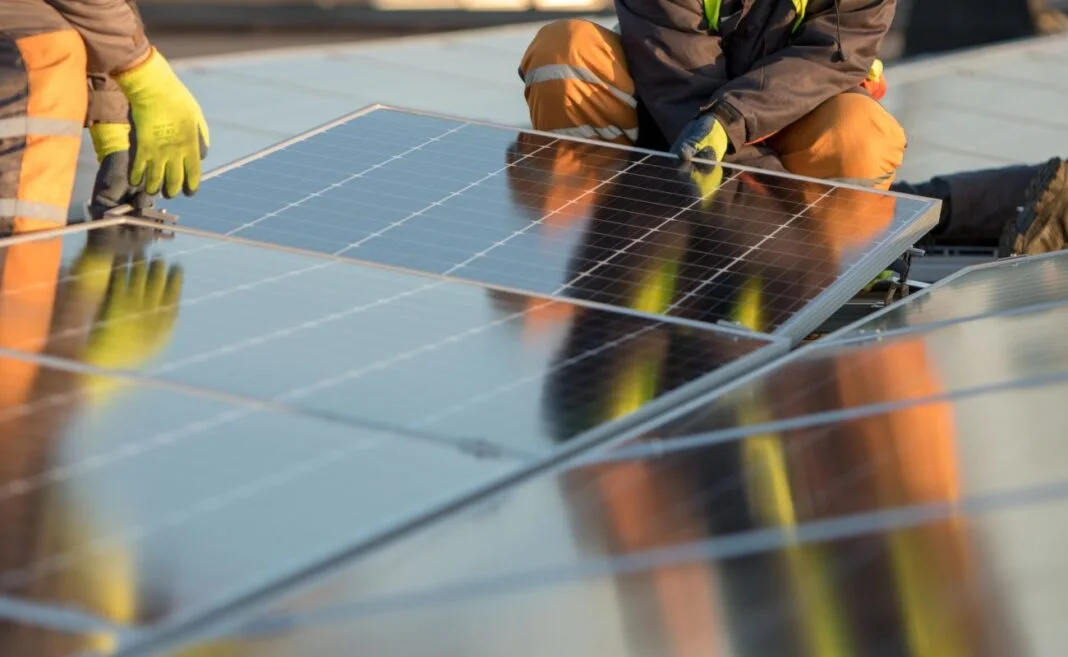

When discussing the energy transition, we usually focus on CO2, electrification, photovoltaic panels, electrolyzers, and energy storage. But there is often a major absentee, a silent yet crucial player, as the European FutuRaM project reminds us. The energy transition is not only about production, consumption, and emission reductions; it also involves — particularly in Europe and Italy — the management of electrical and electronic waste (WEEE). Europe is a major market for a range of products containing critical raw materials (CRMs) essential for electronics, electric mobility, photovoltaics, and other strategic technologies.
Read also the Special report FutuRaM
Waste and Raw Materials
The analyses produced for the European FutuRaM project provide extremely useful data to understand both the present and future of the challenge Europe faces in transforming — effectively and beyond rhetoric — this waste into material streams that enable the energy transition.
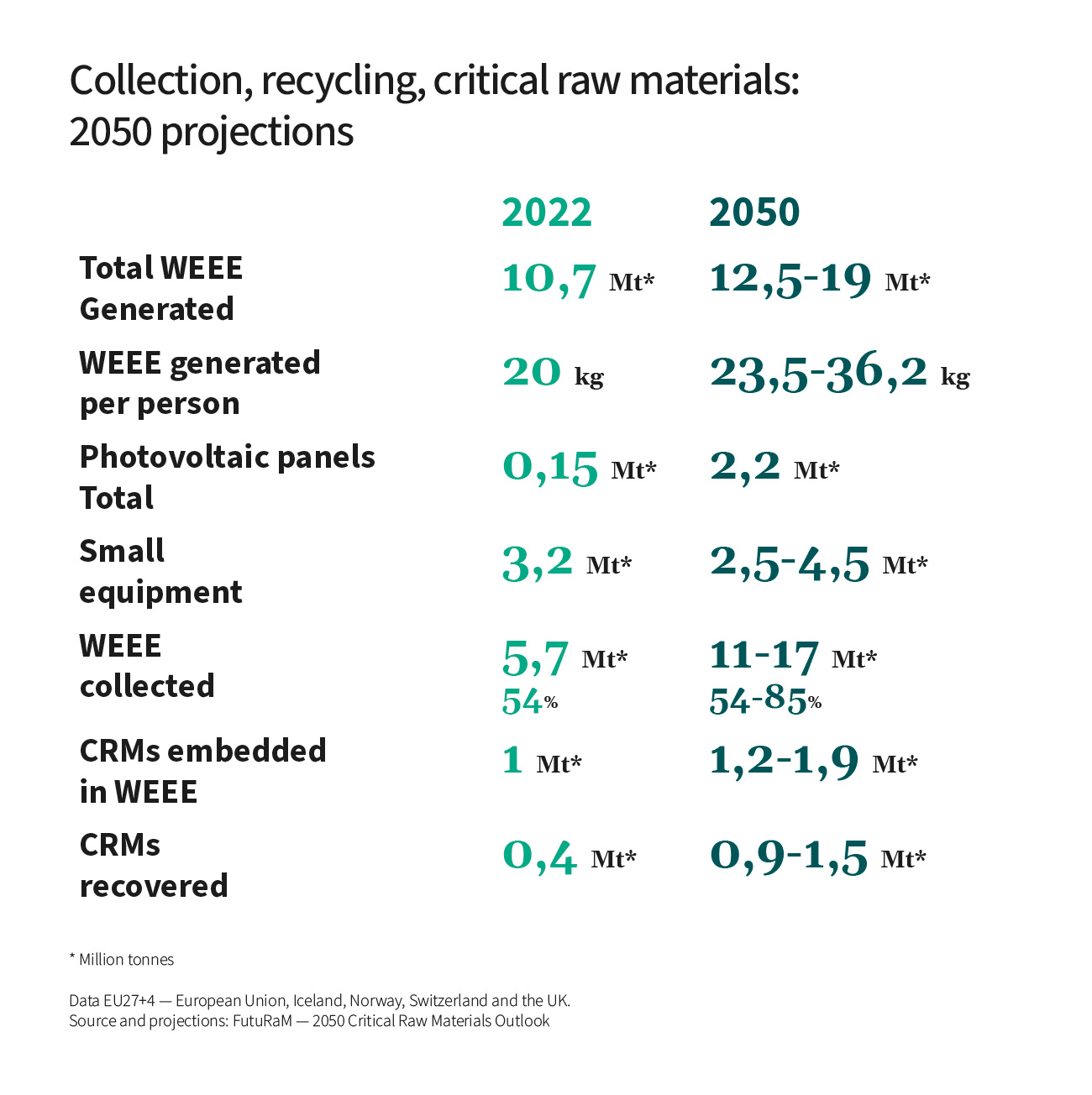
Let’s introduce some key figures. As previously reported (LINK article 4), in 2022, across the EU27+4 area (European Union, Iceland, Norway, Switzerland, and the United Kingdom), 10.7 million tonnes of WEEE were generated, containing approximately 1 million tonnes of critical raw materials (CRMs): copper in cables and inductors, aluminum in casings, rare earths in permanent magnets and fluorescent powders, platinum-group metals in electronic boards and displays, silicon in photovoltaic panels, and tungsten and vanadium in specialized components. But due to several factors — limits related to collection, the maturity of recycling technologies, equipment design, and information on the presence, distribution, and concentration of critical raw materials (CRMs) — only 400 thousand tonnes of critical raw materials were made available for recycling. Even this partial recovery contributes to Italy’s and Europe’s dependence on foreign sources, often from geopolitically problematic countries, although the Hormuz crisis reminds us that, in the new global scenario, there may be no entirely non-problematic countries.
FutuRaM analyses take us to 2050. Giulia Iattoni, Assistant Programme Officer at the United Nations Institute for Training and Research (UNITAR) explains: “The future scenarios developed in FutuRaM are not forecasts, but represent possible developments up to 2050 based on changes in collection systems, recycling technologies, and market dynamics, allowing an assessment of how these conditions influence the availability and recovery of critical raw materials from WEEE and the achievement of the targets”.
The Three Scenarios in FutuRaM
For 2050, FutuRaM has defined three main scenarios:
Business-as-Usual (BAU): Projection of current trends. Generated WEEE reaches 19 Mt, driven by strong growth in electronic products and photovoltaic panels. Recovery of CRMs remains limited to current technological capacities.
Recovery (REC): This scenario includes advanced recycling technologies and more efficient collection. The quantity of generated WEEE is similar to the BAU scenario, but the fraction of recoverable CRMs increases thanks to more targeted dismantling and sorting.
Circularity (CIR): This scenario promotes extended product lifetimes, reuse, and repair, reducing total WEEE generation to 12.5 Mt. The fraction recovered increases because the flows are of higher quality and more traceable, although the overall volume of waste is lower.
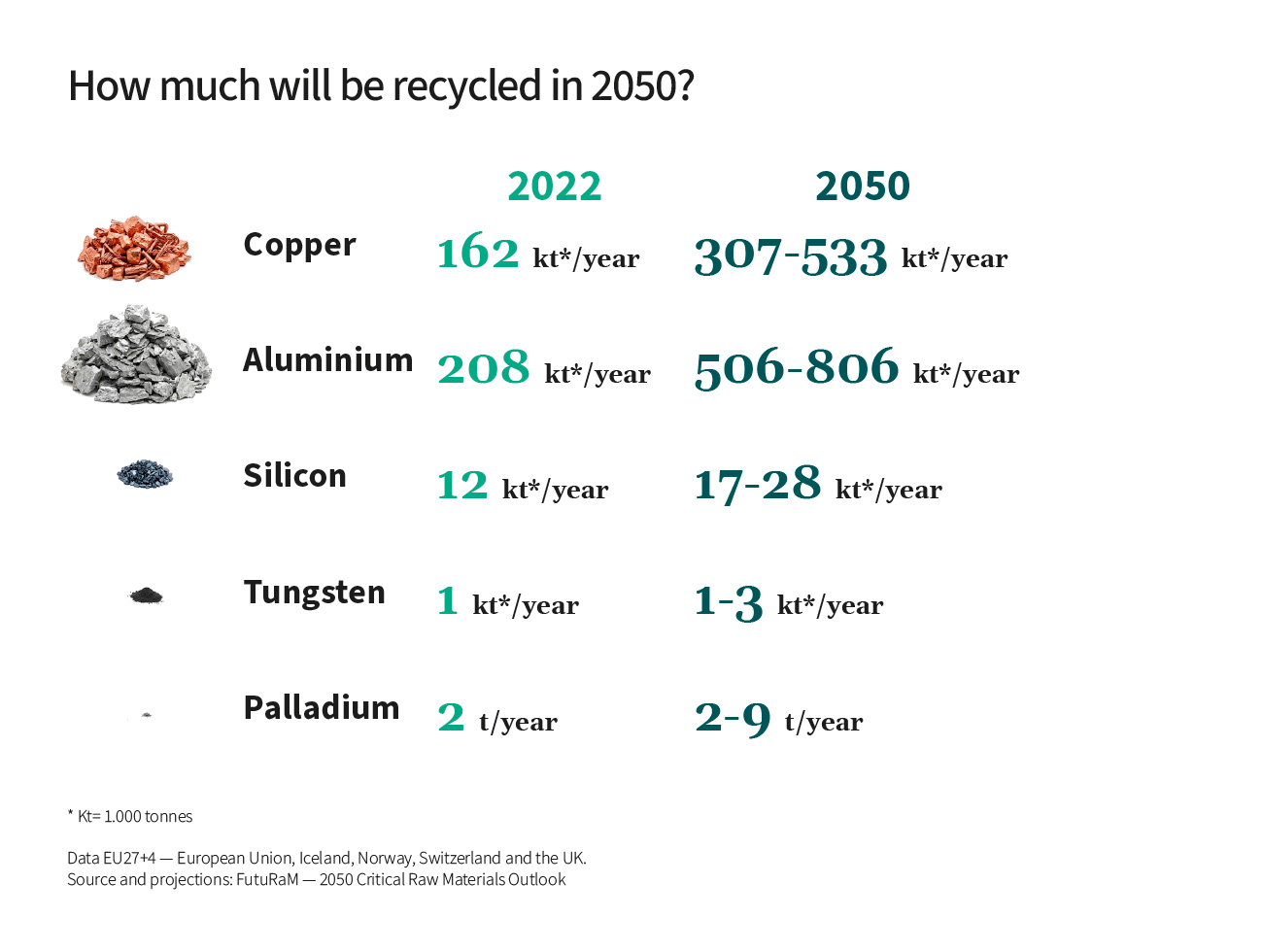
In summary, FutuRaM estimates indicate that the quantity of WEEE in the EU27+4 area could increase from 10.7 Mt in 2022 to a range between 12.5 and 19 Mt by 2050. Critical raw materials contained in WEEE could rise to 1.2–1.9 Mt. The fraction available for recovery could reach 0.9–1.5 Mt, yet significant losses would remain: between 200,000 and 800,000 t during collection, and 100,000–200,000 t during recovery. So even in the best-case scenario, the urban mine won’t yield its resources automatically: the waste it contains must be deliberately redesigned, collected, dismantled, and processed properly.
Read also: Leroy (WEEE Forum): “ FutuRaM? ‘An enabling layer’ for EU CRMs Regulations”
The FutuRaM Method: Hierarchy and Transfer Coefficients
To outline these possible futures, analysts developed a methodology that combines stock-and-flow models with POM (placed-on-market) data to estimate WEEE and CRMs up to 2050. The model tracks materials along a hierarchy from macro to micro (product–component–material–element).
A key element of the FutuRaM method is the transfer coefficients: parameters that estimate, for each material or component in WEEE or other waste, the fraction that is retained, recovered, or lost at every stage of the value chain (collection, dismantling, shredding, separation, recovery). They allow the composition of products to be translated into an estimate of the theoretical recoverability of critical raw materials. They can also be used to model future scenarios and calculate the mass balance of material flows up to 2050.
What is evident is that the energy transition brings new waste streams that will feed an urban mine of strategic materials. However, if we do not want this mountain of waste to remain merely a problem and instead turn it into an industrial and strategic opportunity, we will need to deploy planning, advanced technologies, adequate compliant collection, component identification, and granular data to monitor the quantity, quality, and accessibility of these materials.
For this reason, according to Pascal Leroy, Director General of the WEEE Forum, which brings together 49 producer responsibility organisations for WEEE worldwide, FutuRaM is “part of a broader security‑of‑supply strategy: reducing dependence on a few non‑EU suppliers for materials essential to the green, digital and defence transitions, and aligning secondary resource planning with primary raw materials policy”.
© All Rights Reserved
Download the full FutuRaM Special as a PDF