



There is a point in European industrial policy where the green transition is no longer just about clean technologies but also about data. Knowing how many critical raw materials (CRMs) are already present in the European economy, where they are located, in which products, components, and waste streams, has become a prerequisite for reducing dependence on external suppliers and building more resilient industrial value chains.
This is the space where FutuRaM positions itself, as a European project funded by Horizon that outlines the future availability of secondary raw materials, with particular attention to critical raw materials (CRMs).
FutuRaM focuses on six main waste streams: end-of-life batteries, electrical and electronic equipment (WEEE), end-of-life vehicles (ELV), construction and demolition waste, slags and ashes, and mining residues. The project has developed methodologies, reporting structures, and digital tools (including the Urban Mine Platform) to model the flows and stocks of secondary materials and CRMs up to 2050, enabling the identification of material hotspots, the assessment of their recoverability, and the simulation of future availability and circularity scenarios. Among the 28 project partners are universities, research institutes, industries, and sector associations from 11 countries, collaborating closely with the European Commission and other key policy stakeholders.
Numbers, Industrial Policies, Resilience
If Europe wants to attempt greater independence from global supply chains, how much can it rely on raw materials already present in the form of goods within Europe? How much can it extract from what, in a suggestive metaphor, we call “urban mines”?
Batteries, WEEE, end-of-life vehicles, construction and demolition waste, decommissioned wind turbines, slags and ashes, mining residues: these are no longer just environmental problems to manage, but potential secondary deposits—to be measured, qualified, and made industrially accessible in order to become a pillar of continental supply and industrial competitiveness. Not by chance, the Clean Industrial Deal identifies the circular economy as a tool to “reduce excessive dependence on third-country raw material suppliers, which is essential to ensure a competitive and resilient market.”
The Objectives of the Critical Raw Materials Act and the Role of Urban Mining
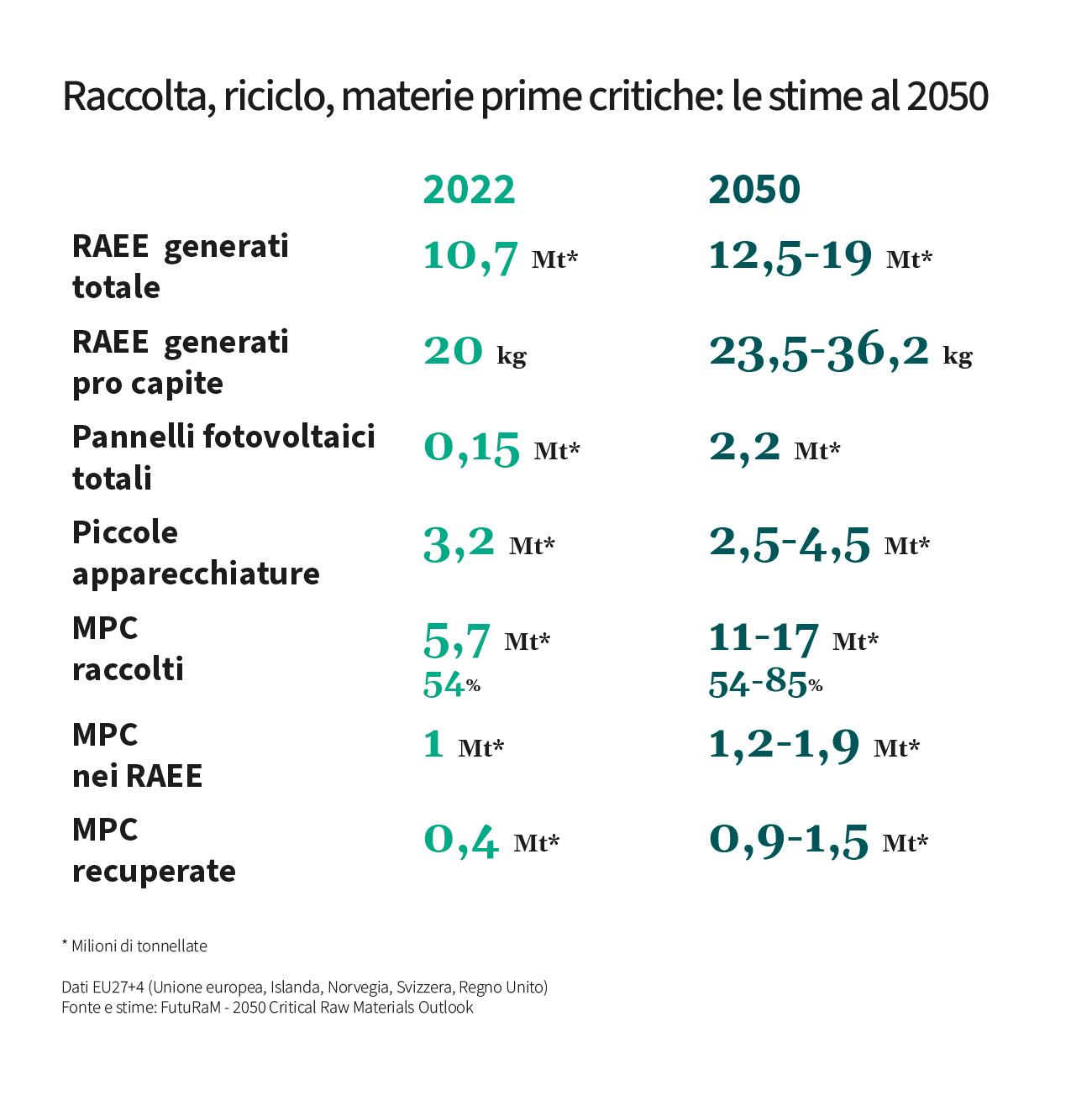
The process is political before being technical. The Critical Raw Materials Act (CRMA) set clear targets for 2030: at least 10% of the EU’s annual consumption of strategic raw materials to be covered by domestic extraction, at least 40% by processing capacity, at least 25% by recycling, and no more than 65% of the supply of a single CRM from one third country.
The European Commission then began translating this framework into an industrial pipeline, approving the first Strategic Projects in 2025: 47 projects within the EU and, subsequently, 13 projects outside the EU. (As an aside, it should be noted that European deregulation—particularly regarding corporate due diligence—could make some of these projects problematic or contradictory to the EU’s ambitions for a just transition.)
In this context, it would be short-sighted (and harmful) to confine recycling to a matter of waste or environmental policy: it is—or at least should be—fully part of European industrial policy (the mentioned Clean Industrial Deal), supply security, and the autonomy and resilience of the industrial system. While the CRMA requires Member States to improve the collection and recycling of waste rich in critical raw materials, FutuRaM adds an essential layer: the ability to distinguish between what is actually present in the waste, what is theoretically recoverable, and what is lost along the value chain. Without this distinction, urban mines would remain a suggestive metaphor—one of the tools of green rhetoric—without providing a tangible contribution to the resilience of European industry.
FutuRaM, therefore, links the achievement of the CRMA recycling target to the need to understand the stocks, flows, and composition of waste. The infrastructural hardware of recycling—although challenged by the lack of adequate political, and even financial, support for European businesses, such as plastic recyclers—is connected to the software of information and knowledge that should inform a European industrial policy worthy of the name.
For this, according to Pascal Leroy, Director General of the WEEE Forum, which brings together 49 producer responsibility organisations for WEEE worldwide, this project is “part of a broader security-of-supply strategy: reducing dependence on a few non-EU suppliers for materials essential to the green, digital and defence transitions, and aligning secondary resource planning with primary raw materials policy.”
The Recycling and Information Gap
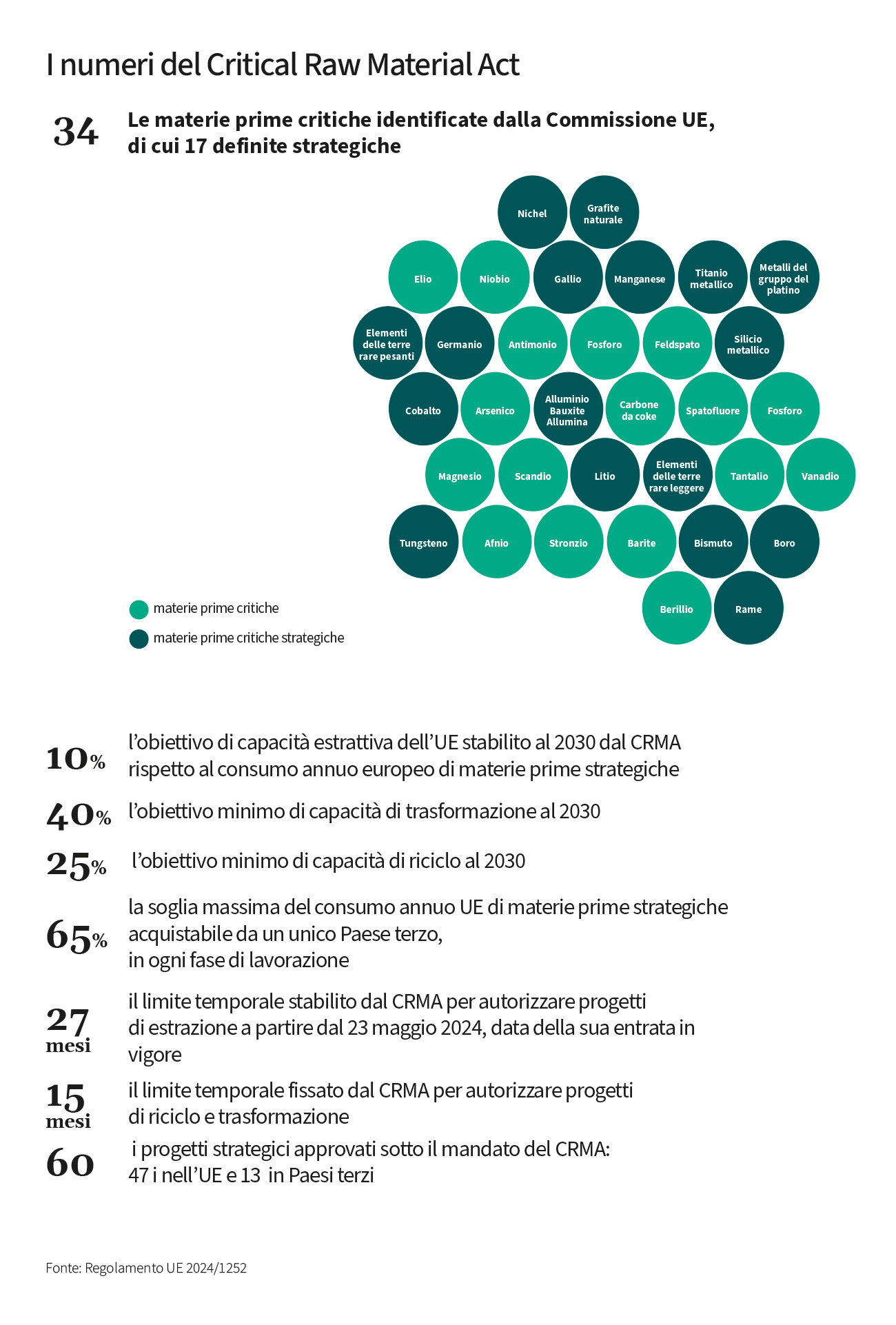
One of the most significant results of the project is the estimate of Europe’s raw material capital contained in our electrical and electronic waste, and how much of this capital is lost. In 2022, in the EU27+4 area (European Union plus Iceland, Norway, Switzerland and the United Kingdom), 10.7 million tonnes of waste electrical and electronic equipment (WEEE) were generated, roughly 20 kg per person. These wastes contained approximately 1 million tonnes of 29 critical raw materials.
However, only 5.7 million tonnes of WEEE — 54% of the total — were collected and properly treated, from which about 0.4 million tonnes of critical raw materials were recovered.
But let’s try to flip the perspective, as when looking for “hidden” objects in an image with optical effects. Let’s focus not on what we manage to recover and recycle, but on what we are still unable to collect and recycle, even though it is right at hand—inside our homes, on our streets, on our rooftops.
Shifting from a positive to a negative view, FutuRaM tells us that, in 2022, approximately 5 million tonnes of WEEE — 46% of the total — did not enter appropriate management channels: some ended up in improper or non-compliant recovery processes, which sacrifice the most valuable parts; some went to mixed municipal waste, some were exported for reuse, and some were even lost without a trace.
And, as we know, even in correctly treated flows, a portion of critical raw materials is not recovered—particularly rare earths such as neodymium, dysprosium, yttrium, and europium, essential for magnets, fluorescent powders, and electronics. The reasons for these additional losses are technological (link Article 4), economic, but also informational (link Article 3).
A New Way of Looking at Recycling
FutuRaM attempts to change the lens through which we view recycling. It does not stop at noting that a product contains copper, aluminium, palladium, or rare earths; it highlights the industrial necessity of knowing which component they are in, what materials are associated with it, whether the component can be separated, whether a treatment technology exists, whether recovery is economically viable, and whether the regulatory framework incentivises it.
The goal is both to increase collection and to improve its quality, as Giorgio Arienti, Director General of Erion WEEE, Italy’s producer responsibility system for WEEE, explains: “FutuRaM clearly shows that collecting more is not enough, because quantity without quality does not lead to efficient recovery of critical materials. Collecting more is certainly important, but at the same time it is crucial to collect better: selecting streams, separating materials, and reducing contamination. In practice, batteries, printed circuit boards, and electronic boards must be treated separately to maximize recoverable value.”
To give substance to this statistical, intangible infrastructure, FutuRaM has produced classifications, datasets, stock-and-flow models, transfer coefficients, 2050 scenarios, and proposals to improve European statistics on secondary raw materials. It has also developed an Urban Mine Platform to navigate this knowledge base and “assess the availability and recoverability of secondary and critical raw materials in Europe.”
All of these are tools necessary to build competitiveness, resilience, and decarbonisation in European industry.
“The message of FutuRaM is that WEEE, along with other types of waste analysed in the project—including batteries, vehicles, construction and demolition waste, mining waste, industrial slags and ashes, and wind turbines—represents a strategic source of secondary raw materials for Europe,” says Giulia Iattoni, Assistant Programme Officer at the United Nations Institute for Training and Research (UNITAR). “Data show that significant volumes of critical raw materials are already present in waste flows and will increase further by 2050, but their effective recovery depends on political, infrastructural, and technological choices.”
© All rights reserved
Download the full FutuRaM Special as a PDF



)